Walking, rocking, flapping: what 36 AI studies reveal about movement in autism
A scoping review gathered research that uses cameras, sensors, and artificial intelligence to analyze gait and repetitive motor movements. Here is what they measured, why they are not ready to diagnose, and what to notice at home.
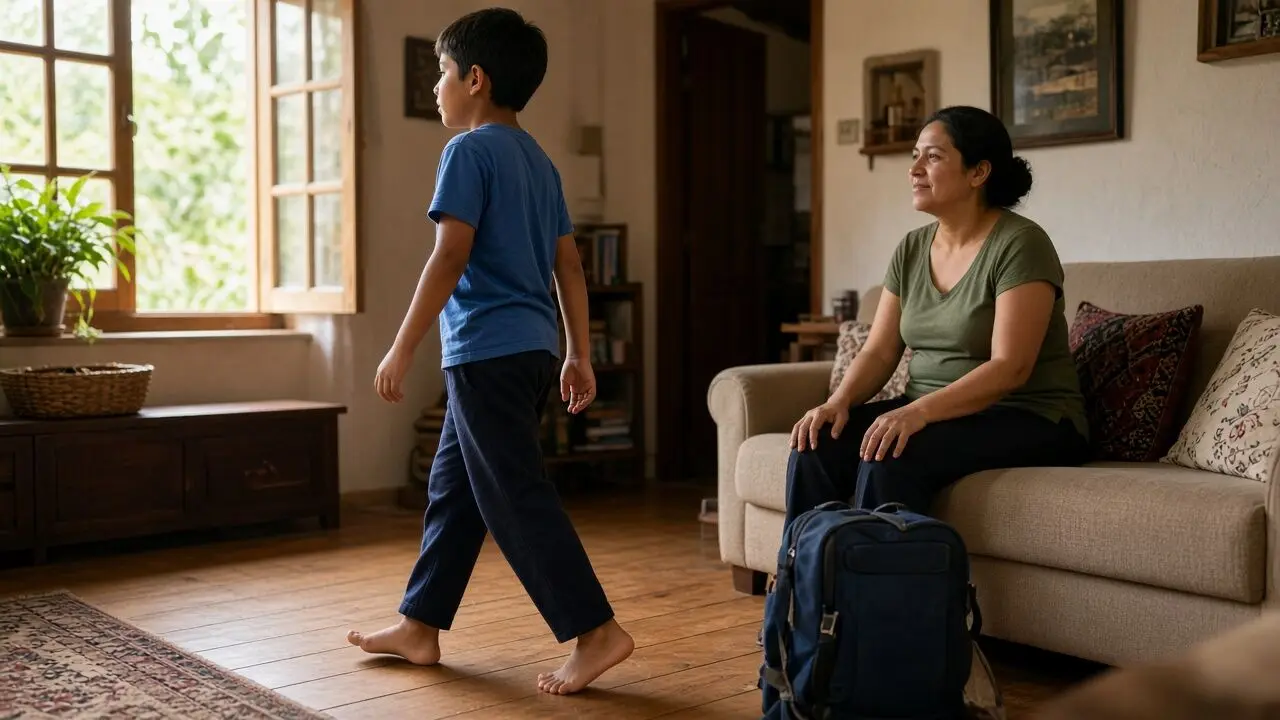
Some mornings you notice your child walking on tiptoe toward the kitchen, rocking on the sofa before breakfast, or flapping their hands when excitement runs high. Those ways of moving are part of everyday life, and many families wonder what they mean. A 2026 review gathered what artificial intelligence has already tried to measure about gait and repetitive motor movements in autistic people—and its conclusion is clear: today this work supports research, not diagnosis.
What they studied
Imane Rachidi and Ghazal Rouhafzay, at the Université de Moncton (Canada), ran a scoping review following PRISMA-ScR. Between March and April 2026 they searched PubMed, Scopus, and IEEE Xplore for papers that used computer vision, pose estimation, or artificial-intelligence models (from classical algorithms to deep networks) to analyze body movement linked to autism.
They started with 168 records; after removing duplicates and applying criteria, they read 36 full-text articles that met inclusion. Adding the reported counts (not unique individuals), those studies involved 1,538 people: 920 autistic and 618 typically developing or control. Most were children, especially in early and school-age developmental ranges; adolescents and adults were underrepresented. Where sex was reported, males predominated.
Sensors ranged from RGB video and depth cameras (Kinect) to Vicon-style motion capture, force plates, and wearable inertial units. The usual pipeline: record movement, clean it, extract features (kinematics, gait parameters, skeletal trajectories), then classify them with AI models.
What they found
Gait took half of the literature: 18 of 36 studies (50%). Stereotyped motor movements—such as hand-flapping or body rocking—appeared in seven (19.4%). The rest looked at fine motor skills, gestures, hand and wrist motion, or other whole-body actions.
On methods, classical algorithms (support-vector machines, random forests, conventional neural nets) remain most common (55.6%), followed by deep networks (33.3%). Supervised approaches dominate: 34 of 36 papers (94.4%).
Several teams reported very high accuracy when distinguishing, within their own data, autistic people from typically developing peers, or when detecting repetitive behaviors. For example, Ilias and colleagues reached 98.44% accuracy on a gait classification task with motion capture; Colella and colleagues reached 98.92% with Kinect skeletons and a graph attention network. The review authors stress that those figures cannot be compared across studies or treated as proof of usefulness for screening or diagnosis: they depend on the sensor, sample size, protocol, and how the data were split.
The synthesis is sober: current evidence supports technical movement analysis, not validated autism screening or diagnosis. Motor differences are also not specific to autism; they appear in other neurodevelopmental and neurological pathways.
What we still don’t know
The paper itself lists limits worth keeping in view:
- Many datasets are small, private, or collected in the lab; external validation is rare, so real-world performance is unknown.
- Protocols, sensors, and metrics differ so much that fair cross-study comparison is hard.
- In several studies the same person contributes many video clips or gait cycles; if those pieces mix across training and hold-out partitions, accuracy can be inflated.
- Screening and data extraction were done by a single reviewer (though a second author checked the work), and the search was limited to English-language texts.
- Samples are often narrow: few adults, incomplete demographics, and a predominance of males.
- Editorial favoritism is possible: strong results surface more easily than modest or negative ones.
- Systems have not yet shown that they improve everyday assessment, follow-up, or decisions for the adults who support the child; prospective research in representative populations is still needed.
In short: the technology advances in the lab; it does not yet replace multidisciplinary judgment or human accompaniment.
What we can take home
Even though these studies used cameras and algorithms, they leave useful ideas for home:
- Treat movement as information, not a label. How your child walks, manages a step, or uses their hands when excited are clues to their real developmental level. Noting a couple of concrete moments in the week (without secret recording or pathologizing) helps you talk more clearly with people who support them outside the home.
- Practice inside the routine, not as a drill. Walking together to the corner, carrying a light bag, going up and down the same step with support if needed, or taking short turns imitating gestures in a game all strengthen coordination without turning the house into a laboratory.
- Respect movements that regulate. Rocking or flapping can be a way to organize amid noise, waiting, or joy. Instead of cutting them off abruptly, ask what the body needs in that moment: more space, fewer stimuli, or a shared rhythm with you.
The next step: meet your child at their developmental stage with TAEO | EdTech
This review confirms something that guides our approach: neurodevelopment is also read in the body—in gait, coordination, and repeating gestures—and each person expresses it differently. That is why TAEO | EdTech does not start from a label or chronological age. The Skills and Competencies Profile covers the eight aspects of neurodevelopment, among them the psychomotor one, and shows what your child already does. From there, the platform orders everyday proposals matched to their real level. Those proposals are the same for every family; what changes is the path. No app identifies autism or analyzes video with artificial intelligence; what we can offer is daily accompaniment to strengthen those skills step by step.
At the TAEO Psychoeducational Organization we have poured more than sixteen years of experience into TAEO | EdTech so every family has clear activities and a human team that guides them step by step.
For our official launch in December 2026, you can request an invitation to the free trial using the form below.