When background noise won’t fade: genes, cellular memory and sensory homeostasis
A Genes review proposes how autism-associated genes may affect neurons’ ability to recalibrate what is familiar. Here are the framework, the numbers, and what families can take home.
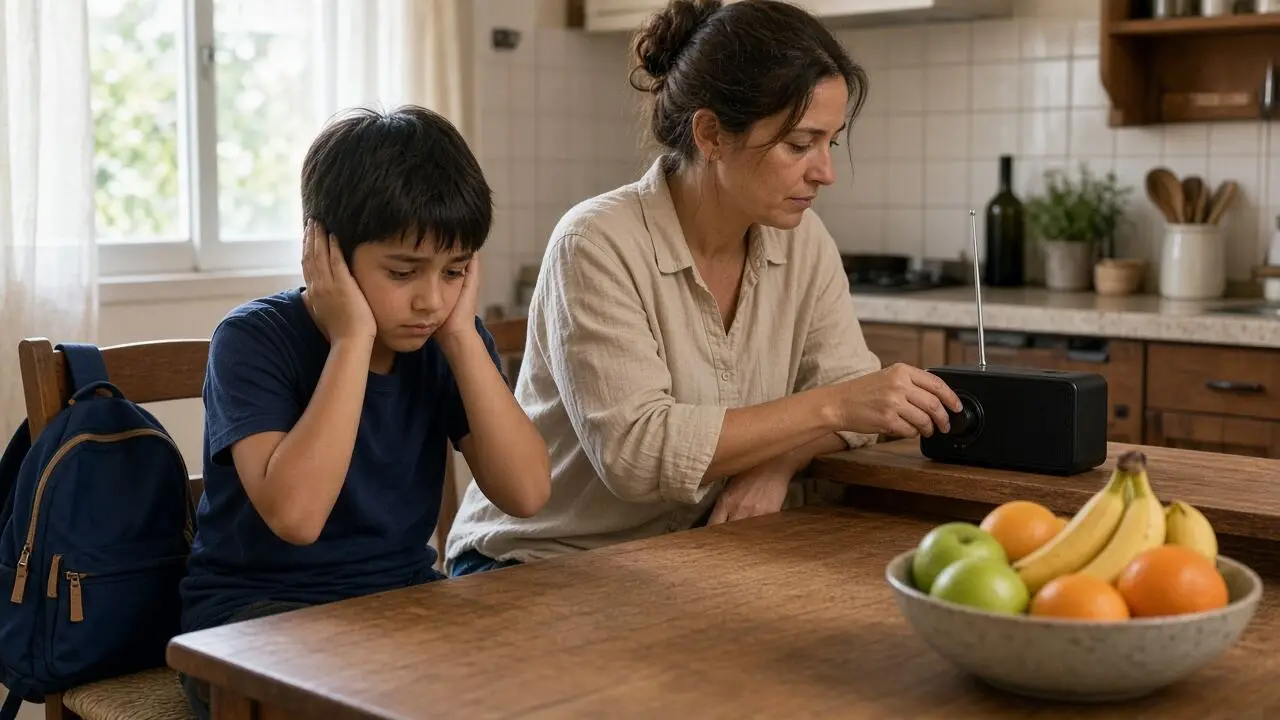
The clothes you are wearing, a fan’s hum, or kitchen smells usually stop claiming center stage. What is new or urgent keeps its salience. That ability to dial down constancy while staying open to change is what this review calls sensory homeostasis. When it falters—when familiar noise keeps flooding in, or a mild cue feels overwhelming—many families of autistic children recognize it at home. A 2026 article in Genes asks whether genes already linked to autism, studied separately, can be arranged in a sequence that explains why that recalibration fails.
What they studied
John Jay Gargus, of the University of California, Irvine, and NeuroQure (United States), published a hypothesis-driven narrative review, not a PRISMA-style systematic review. He started from a prespecified set of 185 autism-associated genes from the Fu and colleagues sequencing study (the “Fu-185”), and graded genetic and mechanistic evidence separately. Supporting literature was sought through September 2026 in PubMed and Google Scholar, with primary experiments and large-scale sequencing prioritized.
The question was not “which gene causes autism?” but whether known gene functions support a directional hierarchy: how neuronal activity leaves a trace that changes the next response. The author calls that trace adaptive cellular memory—a reversible shift in cell state, not conscious recollection or behavioral learning.
What they found
The proposed Signal to Memory (S2M) framework organizes a 44-gene core into three levels:
- Signal generation and organization. How membrane and synaptic activity become dynamically organized intracellular calcium signals. IP3-receptor–mediated release from the endoplasmic reticulum is highlighted as an important, but not exclusive, convergence point.
- Decoding. Proteins that read the amplitude, duration, or frequency of that signal and turn it into electrical, biochemical, synaptic, or transcriptional consequences.
- Transcriptional and chromatin memory. Machinery that stabilizes, constrains, or ends activity-induced gene programs so the cell does not respond the same way next time.
Of those 44 genes, 32 belong to the Fu-185 (17.3% of the 185-gene set; 72.7% of the mapped core). The 32 span all three levels: 13 in Level 1, 6 in Level 2, and 13 in Level 3. Thus 59.4% (19 of 32) help build or interpret activity-dependent calcium signals.
The central prediction is not a single baseline abnormality (always more sensitive or always less), but an abnormal trajectory across repeated stimulation: adaptation may be insufficient, excessive, delayed, unstable, or generalized beyond the eliciting cue. That could contribute to sensory hyperresponsiveness, hyporesponsiveness, or sensory seeking without requiring the same proximal cause in every person.
What we still don’t know
The author is explicit: S2M is a bounded, testable working map, not a definitive classification or a new gene discovery.
- It is not a systematic review or unsupervised enrichment analysis; placing each gene required judgment across heterogeneous evidence.
- The Fu-185 mainly reflects rare coding-variant association and does not capture the full contribution of common, noncoding, or highly polygenic variation. Many genes also relate to intellectual disability, developmental delay, or epilepsy: membership marks association with autism ascertainment, not specificity.
- Protein interaction, pathway annotation, or chromatin regulation “in general” is not enough for placement in the hierarchy.
- Cellular adaptation cannot be assumed to equal perceptual habituation; dynamic trajectories (initial stimulus, repetition, recovery, renewed familiar cue, novel comparison) must be measured in cellular, organoid, or animal systems and linked to quantitative sensory phenotypes.
- The framework would be strengthened if the earliest abnormal step matches the gene’s assigned level and variant-specific correction restores the trajectory; otherwise the map would need revision.
In short: it proposes a bridge from genetics to cellular physiology; it does not yet show that this pathway mediates every sensory difference, and it does not authorize drugs, diets or health procedures.
What we can take home
Although the paper discusses calcium and chromatin, it leaves practical ideas for home life—without replacing guidance from the family’s health team:
- Repetition matters. If a sound, texture, or light feels different the first time than the third, watch that arc. Offer the same cue in short, predictable doses with pauses, rather than one long forced exposure.
- Turn down the constant, don’t erase the world. When background noise or clothing tags have faded for you but not for your child, reduce the load (volume, labels, lights) and name or point to what matters now. At home, sensory homeostasis is also redesigning the setting.
- One label does not explain every body. The review stresses that different proximal causes can converge on poor recalibration. Look at what your child does in each routine instead of assuming a single sensory “type” for every situation.
The next step: meet your child at their developmental stage with TAEO | EdTech
This review supports a view that guides our work: development happens in the whole body and in everyday life, and each person recalibrates sensory input in their own way. That is why TAEO | EdTech does not start from a label or from age, but from the Skills and Competencies Profile, which walks through the eight aspects of neurodevelopment—including the sensory aspect—and shows what your child already does. From there the platform orders daily step-by-step activities, the same for every family; what changes is the path. No app measures calcium signals or chromatin programs; what we can offer is everyday accompaniment so those recalibrations can be practiced calmly at home.
At the TAEO Psychoeducational Organization we have poured more than sixteen years of experience into TAEO | EdTech so every family has clear activities and a human team that guides them step by step.
For our official launch in December 2026, you can request an invitation to the free trial using the form below.